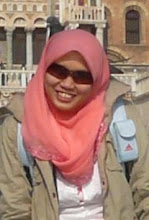
Hola!. Kali ni I nak bercerita pasal Spanish culture la pulak. Asyik cerita pasal Japanese culture je, sesekali nak jugak beralih angin ke Europe ye tak?.  I sempat menonton bull-fighting dengan kawan2 Malaysian yang lain masa kat Madrid zaman muda2 dulu eheh *sekarang ni tak berapa muda dah la*. There are two bullrings in Madrid - Vista Alegre and Las Ventas. Plaza de Toros Monumental, Las Ventas has a capacity of 20,000 is where the majority of the fights take place.

 *outside of the Plaza de Toros Monumental, Las Ventas, Madrid*
 *outside of the Plaza de Toros Monumental, Las Ventas, Madrid*
Bullfights in Madrid are held every Sunday at 7 pm from mid-May (during the San Isidro festival) until October. We went to watch the last show for the year 2006 which was held on 28th October. This Spanish-style bullfighting is called "corrida de toros" (literally a "running of bulls"), or fiesta brava.
 *outside of the Plaza de Toros Monumental, Las Ventas, Madrid*
 *outside of the Plaza de Toros Monumental, Las Ventas, Madrid*
• Firstly the bull is let into the ring.
• Then, the top bullfighter called the Matador, watches his chief assistant wave a bright yellow and magenta cape in front of the bull to make it charge. He watches this in order to determine the bull's qualities and mood, before taking over himself. → Stage 1 : Tercio de Varas ("Lances Third")
• Then a trumpet is sounded and several fighters called Picadores weaken the bull by placing spears into it. This takes around 10 minutes. → Stage 2 : Tercio de Banderillas ("little flags third")

*Bull in the arena with banderillas on flanks* (pic credit : wikipedia)
• Another trumpet is sounded and the Matador now removes his black winged hat and dedicates the death of the bull to the president or the crowd before beginning his faena :-
→ The faena which is the most beautiful and skillful section of the fight and where the matador must prove his courage and artistry.
→ The faena consists of a running at the Matador carrying a muleta (a piece of thick crimson cloth draped over a short stick), which can be held in either the left hand or draped over the espada (the killing sword), which is always held in the right hand.
→ Usually the muleta, in left or right hand, is first held in front of the matador to make the bull charge and is then swung across and away from the matador's body hopefully taking the bull with it.
→ This is a show, basically a dance with death - one wrong move and the Matador could become impaled on the horns of the bull. It is the Matador's job to make this dance dramatic and enjoyable for the audience. The faena continues until the Matador has demonstrated his superiority over the bull. Once this is achieved the bull is ready to be killed.

→ The matador stands some ten feet from the bull, keeping the bull fixated on the muleta and aims the espada between the shoulder blades. The matador attacks pushing the espada over the horns and deep between the shoulder blades.

*pic credit : wikipedia*
→ If the sword goes in to the hilt it is an estocada but if it hits bone it is a pinchazo or media-estocada. An estocada usually results in the bull dropping immediately to its knees and dying, but if the bull fails to die the matador may take the descabello (a sword with a short cross piece at the end) which he stabs into the bull's neck severing the spinal cord. The fight is over.

*pic credit : wikipedia*
→ The matador may be awarded trophies by the president, according to his skill in working with the bull, which can be one or two ears from the bull, the tail and the hoof.
→ The crowd will often encourage the president to award the trophies by waving white hankerchiefs, and this waving continues after the trophies have been awarded. *sumpah masa tengah tengok ni kami tak faham kenapa orang duk lambai2 saputangan huhuhu nganga je lah kami berenam kat situ*  kui3x.

*6 orang budak Malaysia yang tak faham apa2 masa tengok show ni ngee*
While watching the show, we felt really sorry  to the bull sampai satu tahap tu I rasa tak sanggup lagi nak tengok huhu. Bullfighting is normally fatal for the bull, and it is also very dangerous for the matador. Some matadors have been gored many times. A special type of surgeon has developed, in Spain and elsewhere, to treat cornadas (horn-wounds). The bullring normally has an infirmary with an operating room, reserved for the immediate treatment of matadors with cornadas.

*muka cuak sebab kesian tengok lembu2 tu*
Yang paling best bagi I untuk dilihat masa bullfight ni ialah costumes wears by the matadors which are inspired by 18th century Andalusian clothing. Matadors are easily distinguished by their spectacular and quite costly traje de luces "suit of lights" which is custom-made and embroidered with silver or golden thread.

Masa kat Madrid jugak, I sempat masuk dalam bullring tu with my classmates when we went to Aranjuez. Since it is in November, the bullring is not in used and pak guard tu dengan baik hatinya let us wander inside the bullring for taking pictures. Sempatlah jugak kami buat aksi berangan2 jadi matador kat situ  ekekeke.

*inside a bullring at Aranjuez*

*inside a bullring with EuMAS 2006-2008 classmates at Aranjuez*
I jugak sempat buat aksi akrobatik ala2 matador yang ketakutan  di kejar lembu eheh. I suka2 je main panjat2 fence tu without noticing the fact that my friends capture this embarrassing moment. But then, I think I should be thankful to my friend for capturing this controversial picture so that everytime I tengok gambar ni je, I surely will gelak besar dengan ke'tolol'an diri sendiri muahahahaha.

*gambar kontroversi diri sendiri untuk digelakkan seumur hidup*
# Info gathered from : go spain, spain info, wikipedia
Pssssttt : masa gila2 di zaman muda belia remaja memang indah untuk sesekali di kenang oleh seorang mak budak kan? *wink wink*


 *macam I yang tak banyak menuntut ilmu agama nih* huhuhu *mode: insaf*.