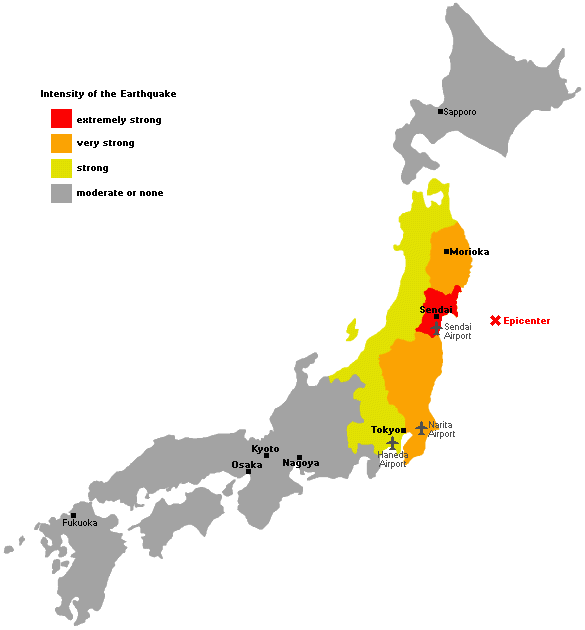
The death toll is likely to rise as there are few casualty counts yet from the worst-hit areas. It has been confirmed that two passenger trains containing an unknown number of passengers disappeared in a coastal area during the tsunami.[full details : HERE] It has also been confirmed that a ship carrying 98 people was swept away by the tsunami. The current status of the ship is still unknown.[full details: HERE]
Last night, I was in ready-mode for any possibilities of tsunami to occur in our place too as our home is just 1km away from the seaside. Though I'm not that good in understanding Japanese language, I switch ON the TV 24hours to watch new updates from the news and also from Japanese government. I was sleepy but I can't go to sleep as I was worrying about so many things.
(1) I was worrying about my friend's (Hana Sakura) condition in Sendai :-
→ I was hoping that they could survive from the waves, and if they are somewhere out there is going to be really difficult to live with no electricity, no gas, and no clean water source in this shivering winter. Plus, snow was reported too yesterday, which making thing worst for them.
→ Around 200 to 300 bodies were found in Sendai's Wakabayashi Ward, the Miyagi prefectural police said. Officials of the ward facing the Pacific Ocean said almost all of the approximately 1,200 households within a district for which a tsunami alert had been issued were affected by tsunami waves.

+- cars and plane as debris -+

+- sendai airport -+

+- sendai airport -+
# latest update [1:34 p.m] --> "Hanis berada di embassy dan masih selamat cuma masih tak pasti bila boleh pulang ke Sendai kerana keadaan di Tokyo masih belum stabil". --> source: HERE
→ As out home is just 1km away from the seaside, I set myself to be in "ready-mode" at all time. Though we are living on the 5th floor, I still think that 'prevention is better than cure'. I keep myself updated with latest updates about tsunami observation site which provide Estimated Tsunami Arrival Time; provided by the Japan Meteorology Agency.

(3) Aftermath issues
→ The effects of the quake included visible smoke rising from a building in the Port of Tokyo with parts of the port areas being flooded, including soil liquefaction in Tokyo Disneyland's carpark.[full details: HERE][and HERE]
→ Shinkansen bullet train services in and out of Tokyo were suspended, though there were no derailments; Narita and Haneda Airport both suspended operations after the quake, with most flights diverted to other airports until further notice.[full details: HERE] Various train services around Japan were also cancelled, with JR East suspending all services for the rest of the day.[full details: HERE]
→ According to Tohoku Electric, around 4.4 million households in northeastern Japan were left without electricity.[full details: HERE] Several nuclear and conventional power plants went offline after the earthquake.
→ An oil refinery of Cosmo Oil Company was set on fire by the quake at Ichihara, Chiba Prefecture to the east of Tokyo.[full details: HERE] Major fires broke out elsewhere, such as in the city of Kesennuma.[full details: HERE][and HERE]
→ Japan's transport network suffered as well. Many sections of Tohoku expressway serving northern Japan have been damaged.[full details: HERE] Many railways services were suspended in Tokyo, with an estimated 20,000 people stranded at major stations across Tokyo. In the hours after the earthquake, some train services were resumed.[full details: HERE]
→ According to an unnamed official from Chunghwa Telecom, the earthquake has caused "some damage" to an undersea cable near Kita on the eastern coast of Japan but data transmission hasn't been interrupted.[full details: HERE]
As for this morning, [ET, 5:56 a.m. Tokyo] An estimated 6.3-magnitude earthquake has hit near the west coast of Honshu - the latest in a series of aftershocks and fresh temblors that struck on and around Japan's largest island within a span of 70 minutes early Saturday morning. A 6.2-magnitude quake hit at 3:59 a.m., followed by six more with magnitudes no less than 5.2. --> info from HERE
What's next for Japan? Robert Jensen, whose company assists in natural disaster recovery efforts, says, "right now Japan is in the life-saving, immediate-response mode, not the recovery mode. In the next several days as it moves to recovery mode, Japan will have to take care of its citizens and meet the basic needs of food, water and shelter." The Japanese are very good at this, he says, but the scope and scale this time are significantly greater. "Japan hasn’t seen damage like this since World War II."--> Read the full post at Global Public Square blog
The advantage about living in Japan is that they are very efficient in :-
(1) Providing latest information
Japan is located near an active subduction zone experiencing many earthquakes and tsunamis. Therefore, Japan has developed one of the most extensive tsunami warning systems in the Pacific, and worldwide. The following describes the local notification methods used in Japan:--> full details HERE
- Simultaneous Announcement Wireless System (SAWS)
SAWS is a system of transmitters and receivers installed by local authorities for all types of messages. Transmitters are located in the local government offices and receivers are placed in hospitals, schools, fire stations, emergency management offices and other locations. - Mobile Announcer System
Fire-trucks equipped with loudspeakers cruise the areas which are not covered by the SAWS. - Television and Radio
A tsunami warning is given the priority to interrupt ongoing programmes on both government and commercial television and radio stations. The message is either a subtitle on the bottom of the screen, or, a window which shows a map where the watch or warning applies; this is not possible for local tsunamis. - Sirens and bells
In some villages, sirens are installed which prompt residents to turn on their radio or television for further information. Some villages still stick to tradition by clanging a bell to announce a tsunami warning. - Telephone network and word of mouth
Some communities have created telephone networks but in some cases the only way to reach people is by going from house to house. Both methods are time consuming but necessary to reach populations that lack other warning systems.

→ Immediate action on rescue activity has been launched. Prime Minister Naoto Kan announced the government has mobilized the Japanese Self-Defense Forces in various earthquake disaster zones. He asked the Japanese public to act calmly and tune into various media for updated information.
→ He also reported numerous nuclear power plants have automatically shut down to prevent damage and radiation leaks.PM Kan also set up emergency headquarters in his office to coordinate the government's response. --> full details HERE
(3) Japan's Strict Building Codes Saved Lives
→ Had any other populous country suffered the 8.9 magnitude earthquake that shook Japan on Friday Mac 11 2011, tens of thousands of people might already be counted among the dead. So far, Japan's death toll is in the hundreds, although it is certain to rise. Over the years, Japan has spent billions of dollars developing the most advanced technology against earthquakes and tsunamis. --> read full details HERE.
Also, I want to say that joking about "whereabouts are Ultraman, Power Rangers, Gaban and etc" is NOT FUNNY AT ALL!. Try putting yourself in the victim's shoe; what if these happened to you and your family, would you still have the guts to be that super ignorant bitch and say some crappy things like that anymore?

While I'm writing this entry, things are going well here in Fukuoka and getting better in the affected place in the northeast part of Japan. Allah is sending us 'signal' to strengthen our faith and believe, and only in Allah's hand we can relies on and put our hope.
"His Command, when He intends anything, is only that He says to it, "Be' then (and there) it is - (Kun Fayakun)" - Verse 82, SUrah Yaseen.